Citicoline — also called CDP-choline — has attracted interest well beyond its established role in cognitive support. Some researchers and users have begun asking whether this naturally occurring compound might also influence mood, motivation, or the neurochemical landscape underlying depression. The curiosity is not unfounded: citicoline acts on neurotransmitter systems that overlap meaningfully with those implicated in mood disorders, including dopaminergic and cholinergic pathways.
This article takes an honest look at what the current evidence actually supports. The research base for citicoline and mood is narrower than many supplement articles imply, and the available clinical trials have mostly studied cognitive function in older adults rather than depression or motivation in otherwise healthy populations. What follows is a mechanism-grounded, evidence-cited overview — not a promise of antidepressant effects, and not medical advice.
Key Takeaways
- Citicoline acts on dopaminergic and cholinergic pathways — systems directly relevant to mood and motivation — but clinical trials specifically testing mood outcomes in depression are limited.
- The proposed mechanisms (striatal dopamine receptor upregulation, phosphatidylcholine synthesis, cholinergic support) offer a plausible theoretical basis for mood-related interest, but do not confirm clinical efficacy.
- The most robust human evidence for citicoline involves cognitive support in older adults with vascular cognitive impairment, where tolerability was excellent over nine months [1].
- A 2025 review of nutraceuticals across psychiatric conditions reflects growing research interest in this space, though evidence specific to citicoline and mood disorders remains preliminary [2].
- Citicoline is not a substitute for evidence-based depression treatment; anyone experiencing clinically significant depression should seek evaluation from a qualified healthcare provider.
How Citicoline Works in the Brain
Citicoline is a naturally occurring intermediate in the biosynthesis of phosphatidylcholine, a phospholipid that forms a critical structural component of neuronal cell membranes. When consumed, it is hydrolyzed into choline and cytidine, both of which cross the blood-brain barrier independently. Choline is then used to synthesize acetylcholine — the neurotransmitter central to attention, learning, and parasympathetic signaling — as well as phosphatidylcholine itself, which helps maintain membrane fluidity and structural integrity in neurons.
Cytidine, meanwhile, converts in the body to uridine, a nucleoside involved in phospholipid membrane synthesis and believed to play a role in synaptic plasticity. Beyond these foundational pathways, research has suggested that citicoline may upregulate dopamine receptor density in the striatum and increase activity of choline acetyltransferase, the enzyme responsible for producing acetylcholine. These proposed dopaminergic and cholinergic effects form the primary theoretical basis for interest in citicoline as it relates to mood and motivation.
The Neuroscience of Mood: Where Citicoline Might Fit
Depression and low motivation are not single-pathway conditions. While serotonin has historically dominated the popular conversation, current neuroscience recognizes that dopamine, acetylcholine, glutamate, and neuroinflammation all contribute in meaningful ways. Research into glutamate-modulating compounds such as ketamine has substantially shifted how clinicians understand the neurobiology of mood disorders, highlighting the limitations of a purely serotonergic model [3].

Citicoline’s proposed relevance to mood rests primarily on its effects on the dopaminergic and cholinergic systems. Dopamine is closely tied to motivation, reward anticipation, and the capacity to experience pleasure — functions that are frequently blunted in depression. Acetylcholine has a more complex relationship with mood: excessive cholinergic tone has historically been associated with depressive states, though this relationship is incompletely understood. The net effect of citicoline on these balances, in the context of clinical depression, has not been rigorously evaluated in controlled human trials.
What Clinical Research Has Actually Studied
The most substantive human evidence for citicoline comes from trials in populations with cognitive impairment, stroke recovery, and vascular brain injury — not populations with primary mood disorders. The IDEALE study, a prospective observational study, examined citicoline at 500–1000 mg/day in older adults with mild vascular cognitive impairment over nine months. It reported an excellent safety and tolerability profile, with adverse events that were mild and transient [1]. While the trial’s primary endpoints were cognitive rather than mood-related, the tolerability data are relevant context for anyone considering citicoline.
In broader psychiatric research, a 2025 systematic review and network meta-analysis evaluating nutraceuticals and phytoceuticals across psychiatric conditions found evidence for several compounds — including citicoline — within conditions that share neurochemical features with mood disorders [2]. However, the evidence specifically targeting depressive symptoms or motivational deficits remains sparse, and findings in this space require replication in larger, randomized controlled trials before firm conclusions can be drawn.
Citicoline, Dopamine, and the Biology of Motivation
Perhaps the most biologically plausible connection between citicoline and mood involves its proposed effects on dopamine receptor expression. Preclinical and early human research has suggested that citicoline may increase dopamine receptor density in the striatum — the brain region central to motivation, goal-directed behavior, and reward processing. If this mechanism translates meaningfully to humans at supplement doses, it could provide a rationale for modest improvements in low motivation, anhedonia, or apathy.
These mechanisms remain proposed rather than confirmed through controlled human mood trials. What can be said is that the neurochemical targets citicoline engages — striatal dopamine pathways, cholinergic tone, and membrane phospholipid availability — are biologically relevant to the mood disorders clinicians most commonly encounter. Whether supplementation at common doses of 250–500 mg/day produces clinically meaningful mood effects has not yet been established through trials specifically designed to test that question.
Nutraceuticals in Psychiatric Research: Broader Context
Citicoline is one of several nutraceuticals being investigated for neuropsychiatric applications. A 2025 systematic review and network meta-analysis examined a wide range of nutraceuticals and phytoceuticals in psychiatric conditions, reflecting a growing body of serious scientific interest in nutritional and supplement-based approaches to mental health support [2]. This trend is credible but still maturing: individual trials are often small, endpoints vary across studies, and the field lacks the long-term outcome data available for established psychiatric treatments.

This matters for anyone considering citicoline specifically for mood or depression. The compound has a well-characterized safety profile and mechanistically plausible rationale, but the clinical evidence for mood outcomes does not yet match the evidence base for its use in cognitive support. Keeping these questions separate — is it safe, and is it effective for depression — is important for informed decision-making.
Tolerability and Practical Considerations
Across multiple clinical studies, citicoline demonstrates a favorable safety and tolerability profile. The IDEALE study, which followed patients for nine months at doses of 500–1000 mg/day, found adverse events to be mild and transient [1]. At the doses commonly used in supplement contexts — 250–500 mg/day — side effects in reported trials are infrequent, with mild gastrointestinal discomfort or transient headache among the most noted, particularly in individuals sensitive to cholinergic stimulation.
Individuals with bipolar disorder or those taking psychiatric medications should be especially cautious and consult a qualified healthcare provider before adding any supplement that acts on dopaminergic or cholinergic pathways. Even modest influences on neurotransmitter balance can interact unpredictably with existing pharmacotherapy. This information is not a substitute for professional medical advice.
🛒 Where to Buy Citicoline
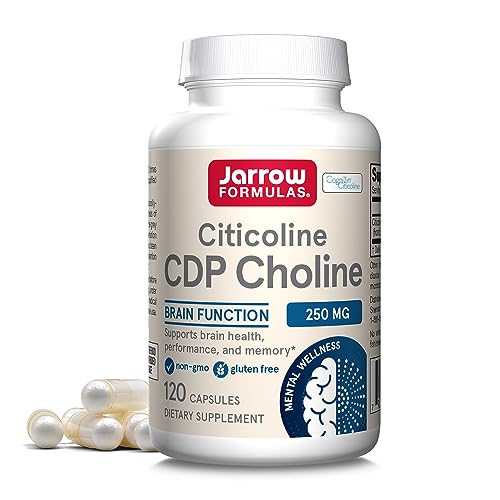
- Jarrow Formulas Cognizin CDP-Choline 250mgLab-tested / studied
capsules, 250 mg citicoline (Cognizin) per capsule, 60 capsules — The benchmark Cognizin-branded product; widely stocked, non-GMO, third-party tested; the go-to reference for price comparisons across the category. - NOW Foods CDP-Choline 300mg
capsules, 300 mg CDP-choline per vegetarian capsule, 60 capsules — 300mg per capsule at a competitive price; GMP-certified, non-GMO; consistently passes independent lab tests; ideal entry point for first-time buyers. - Nutricost Citicoline (CDP-Choline) 500mg
capsules, 500 mg citicoline per capsule, 60 capsules — High-dose option suited to experienced users; GMP-certified facility; budget-friendly; third-party tested; allows easy split-dose regimen at 250mg twice daily. - Double Wood Supplements Citicoline (CDP-Choline) 300mg
capsules, 300 mg CDP-choline per capsule, 60 capsules — Certificates of analysis available; US-manufactured; well-regarded in nootropics forums for consistent potency and transparent testing practices.
As an Amazon Associate we earn from qualifying purchases. Citicoline quality comes down to label accuracy and independent verification. Choose a product that states the exact milligrams of citicoline per serving rather than hiding it inside a proprietary blend, and prefer finished-product certification from NSF, USP or Informed Sport — Cognizin is the branded form named in most published trials, but an independently certified generic carries the same active molecule.
A Note on the Evidence
The clinical evidence for citicoline specifically in mood disorders and depression remains limited; most human trials have focused on cognitive outcomes in older or neurologically affected populations, not mood in the general adult population. Anyone experiencing symptoms of depression, low motivation, or significant psychiatric distress should seek evaluation from a qualified healthcare provider rather than relying on supplementation alone.
Frequently Asked Questions
Does citicoline treat depression?
Citicoline has not been approved by the FDA to diagnose, treat, cure, or prevent depression or any other disease. Clinical trials specifically designed to test citicoline as an intervention for depressive disorder are limited, and the existing evidence base primarily concerns cognitive outcomes. Its proposed mechanisms are neurobiologically relevant to mood, but plausible mechanisms do not equal proven clinical efficacy.
How does citicoline affect dopamine?
Research suggests citicoline may increase dopamine receptor density in the striatum — the brain region central to motivation and reward processing. This is one of the key proposed mechanisms behind interest in citicoline for mood and motivational support. However, the degree to which this translates to clinically measurable mood benefits in humans has not been definitively established in trials targeting mood as the primary outcome.
Is citicoline safe to take for mood support?
Citicoline has a well-characterized safety profile across multiple clinical studies. A nine-month observational study in older adults with mild vascular cognitive impairment found it well tolerated at 500–1000 mg/day, with only mild, transient adverse events [1]. At typical supplement doses of 250–500 mg/day, it is generally considered safe for healthy adults, though individuals on psychiatric medications should consult a healthcare provider before use.
Can citicoline help with low motivation or anhedonia?
Low motivation and anhedonia are closely tied to dopamine signaling in the brain’s reward circuits. Citicoline’s proposed upregulation of striatal dopamine receptors provides a theoretical basis for interest in motivational support, but this has not been confirmed in well-designed human trials with motivation or anhedonia as the primary endpoint. Available evidence does not yet support strong claims about this specific effect.
How does citicoline differ from pharmaceutical approaches to depression?
Unlike glutamate-modulating treatments such as ketamine, which work by rapidly altering synaptic plasticity and have been extensively studied in controlled trials for treatment-resistant depression [3], citicoline acts more indirectly through cholinergic tone and phospholipid biosynthesis pathways. These are fundamentally different mechanisms with very different bodies of clinical evidence; they are not directly comparable as interventions.
Are other nutraceuticals being studied for mood support?
Yes. A 2025 systematic review and network meta-analysis examined a broad range of nutraceuticals and phytoceuticals in psychiatric conditions and found an emerging — if still preliminary — evidence base across multiple compounds [2]. The overall field is active and scientifically credible, but most compounds, including citicoline, require larger and more specifically designed replication trials before they can be recommended as mood interventions.
References
- Cotroneo AM et al. Effectiveness and safety of citicoline in mild vascular cognitive impairment: the IDEALE study. Clinical interventions in aging (2013). PMID 23403474
- Fornaro M et al. Nutraceuticals and phytoceuticals in the treatment of schizophrenia: a systematic review and network meta-analysis "Nutra NMA SCZ". Molecular psychiatry (2025). PMID 39026098
- Dean RL et al. Ketamine and other glutamate receptor modulators for depression in adults with unipolar major depressive disorder. The Cochrane database of systematic reviews (2021). PMID 34510411
These statements have not been evaluated by the Food and Drug Administration. This information is not intended to diagnose, treat, cure, or prevent any disease. Content is for informational purposes only and is not medical advice; consult a qualified healthcare provider before starting any supplement. As an Amazon Associate we earn from qualifying purchases.
