Citicoline — also called cytidine 5′-diphosphocholine, or CDP-choline — is a naturally occurring compound found in every cell of the human body. It is also sold widely as a dietary supplement marketed for cognitive support. Unlike many ingredients in the brain-health space, citicoline has a well-characterized biochemical identity and a set of proposed mechanisms that researchers have been studying for decades, making it one of the more scientifically tractable nootropic compounds available.
This article explains, as plainly as possible, what citicoline actually is, how the body breaks it down and uses its components, and what the proposed neurological effects are. This is a mechanism explainer rather than a trial review: it describes the established biochemical and pharmacological understanding of the compound, with the human pharmacokinetic work that underpins it cited in the References section below. For trial-level evidence, see our review of what the citicoline research actually shows. This is informational content, not medical advice, and citicoline has not been approved by the FDA to diagnose, treat, cure, or prevent any disease.
Key Takeaways
- Citicoline is metabolized into choline and cytidine, and in humans that cytidine is then converted to uridine, so the substrates that actually circulate and reach the brain are choline and uridine.
- Choline serves as a precursor to both acetylcholine (a key neurotransmitter) and phosphatidylcholine (a structural membrane phospholipid), and citicoline may support both pathways simultaneously.
- Cytidine converts to uridine in the body, which also contributes to phosphatidylcholine synthesis and may play a role in neuroplasticity-related processes.
- Proposed mechanisms include enhanced neuronal membrane integrity, increased choline acetyltransferase activity, and upregulation of dopamine receptor density in the striatum.
- At 250–500 mg/day, citicoline has a well-established tolerability profile, though individual responses vary and it is not an FDA-approved treatment for any disease.
What Citicoline Is and How the Body Processes It
Citicoline is an intermediate in the Kennedy pathway — the primary biochemical route by which mammalian cells synthesize phosphatidylcholine, the dominant phospholipid in neuronal cell membranes. It exists naturally inside the body as part of normal phospholipid metabolism, which means supplementing with it is not introducing a foreign molecule but rather supplying a compound the body already produces and uses.
When citicoline is taken orally, it is broken down before absorption into its two constituent parts: choline and cytidine. What happens next is species-dependent, and the distinction matters for anyone reading the animal literature. When twelve subjects were given 500, 2,000 or 4,000 mg of oral CDP-choline, plasma choline and plasma uridine both rose dose-dependently, while plasma cytidine was not reliably detectable at any of the three doses; the investigators concluded that the circulating substrates in humans are uridine and choline rather than cytidine and choline as in rats[1]. In rats, by contrast, oral CDP-choline does raise plasma and brain cytidine directly[2]. The dual-component delivery is still central to why researchers have taken interest in citicoline specifically rather than in choline supplementation alone, but in people the second component reaching the brain is uridine, not cytidine.
The Choline Pathway: Acetylcholine and Membrane Phospholipids
Choline, once inside the brain, is a substrate for two major processes. The first is the synthesis of acetylcholine, a neurotransmitter critical to attention, memory encoding, and the signaling between neurons in cholinergic circuits. The enzyme choline acetyltransferase (ChAT) catalyzes this reaction, combining choline with acetyl-CoA to form acetylcholine. One of the proposed mechanisms by which citicoline may support cognitive function is by increasing ChAT activity, providing more available choline to support this synthesis step.
The second major use of choline in the brain is as a building block for phosphatidylcholine. Phosphatidylcholine is not merely a structural curiosity — it is the principal component of neuronal cell membranes and myelin sheaths. Healthy membrane phospholipid composition is associated with proper receptor function, efficient signal transduction, and the structural integrity of neurons themselves. When dietary choline intake is low, the brain may cannibalize membrane phospholipids to support acetylcholine synthesis, a process that can compromise membrane integrity over time. Citicoline supplementation is hypothesized to provide enough choline to support both pathways simultaneously, avoiding this trade-off.

The Cytidine Pathway: Uridine and Its Role
The second component released when citicoline is metabolized is cytidine, a pyrimidine nucleoside. In humans, cytidine is rapidly converted to uridine, which crosses the blood-brain barrier and enters neurons[1]. Uridine is itself a precursor to additional phosphatidylcholine synthesis via the CDP-choline pathway, effectively providing a second route by which citicoline supports membrane phospholipid availability. That step has been demonstrated in neuron-derived cell culture[2] and in animal brain, where an oral uridine source raised brain CDP-choline levels[3], rather than measured directly in the human brain.
Uridine also plays roles in neuroplasticity-related processes. It is involved in the synthesis of RNA components, and some researchers have proposed that it may support the growth and maintenance of dendritic spines — the small protrusions on neurons where synaptic connections form. This is an area of active investigation, and while the basic biochemistry is established, the clinical significance of uridine-driven effects from citicoline supplementation in healthy humans remains an open question.
Dopamine Receptor Upregulation in the Striatum
One of the more pharmacologically interesting proposed effects of citicoline involves the dopaminergic system. Research has suggested that citicoline may upregulate dopamine receptor density in the striatum — the brain region involved in reward processing, motivation, and motor control. This is not the same as increasing dopamine itself; rather, the proposal is that citicoline may increase the number or sensitivity of receptors that respond to dopamine.
The clinical implications of this mechanism are not fully established, and most of the supporting data comes from animal models or small human trials. It is worth noting this mechanism exists as a proposed pathway rather than a confirmed clinical effect, particularly in the context of healthy adults using citicoline as a general supplement.
Neuronal Membrane Integrity: Why It Matters
The concept of neuronal membrane integrity may sound abstract, but it has practical relevance to how brain cells function. Cell membranes are not passive barriers — they house ion channels, receptors, and transport proteins that regulate virtually every aspect of neuronal signaling. The composition of the lipid bilayer, particularly its phosphatidylcholine content, influences membrane fluidity, receptor conformation, and the efficiency of signal transmission.
As neurons age or come under metabolic stress, phospholipid turnover can accelerate, and the membrane composition may shift in ways that impair function. Citicoline’s proposed role in supporting phosphatidylcholine resynthesis is the mechanistic basis for its investigation in conditions associated with neuronal vulnerability. However, it is important to be honest that supplement-level doses in healthy individuals may produce more modest effects than the larger doses used in some clinical contexts, and the field would benefit from larger, well-controlled trials.
Safety Profile and Practical Considerations
Clinical trials at doses of 250 to 500 mg per day report an excellent tolerability profile for citicoline. The most commonly noted adverse effects, when they occur at all, are mild gastrointestinal discomfort and transient headache. The headache is plausibly related to cholinergic stimulation — the same mechanism responsible for the compound’s proposed cognitive effects can, in some individuals, produce mild discomfort at higher doses or in those who are more sensitive to cholinergic activity.
Citicoline is available without a prescription as a dietary supplement in most countries. It has not been approved by the FDA as a drug to treat any condition. People who are pregnant, breastfeeding, taking medications that affect cholinergic or dopaminergic signaling, or managing a neurological condition should consult a qualified healthcare provider before using citicoline or any nootropic supplement.
🛒 Where to Buy Citicoline
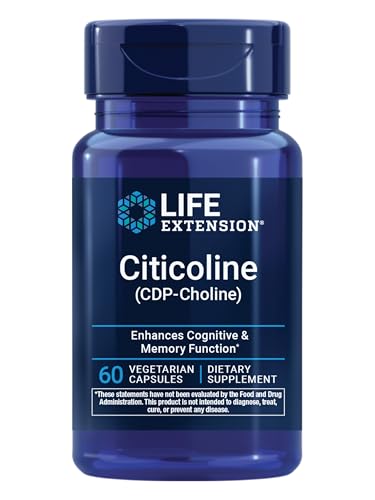
- Jarrow Formulas Cognizin CDP-Choline 250mgLab-tested / studied
capsules, 250 mg citicoline (Cognizin) per capsule, 60 capsules — The benchmark Cognizin-branded product; widely stocked, non-GMO, third-party tested; the go-to reference for price comparisons across the category. - NOW Foods CDP-Choline 300mg
capsules, 300 mg CDP-choline per vegetarian capsule, 60 capsules — 300mg per capsule at a competitive price; GMP-certified, non-GMO; consistently passes independent lab tests; ideal entry point for first-time buyers. - Nutricost Citicoline (CDP-Choline) 500mg
capsules, 500 mg citicoline per capsule, 60 capsules — High-dose option suited to experienced users; GMP-certified facility; budget-friendly; third-party tested; allows easy split-dose regimen at 250mg twice daily. - Double Wood Supplements Citicoline (CDP-Choline) 300mg
capsules, 300 mg CDP-choline per capsule, 60 capsules — Certificates of analysis available; US-manufactured; well-regarded in nootropics forums for consistent potency and transparent testing practices.
As an Amazon Associate we earn from qualifying purchases. Citicoline quality comes down to label accuracy and independent verification. Choose a product that states the exact milligrams of citicoline per serving rather than hiding it inside a proprietary blend, and prefer finished-product certification from NSF, USP or Informed Sport — Cognizin is the branded form named in most published trials, but an independently certified generic carries the same active molecule.
A Note on the Evidence
The underlying biochemistry of the CDP-choline pathway is well established, but that is not the same as knowing how citicoline works as a supplement: a review of its clinical pharmacology concluded that there is at present no adequate description of the mechanism or mechanisms behind its pharmacological actions, and that two large pivotal trials in ischaemic stroke and traumatic brain injury found no benefit[4]. Many clinical trials are also small, short-duration, or conducted in populations with specific health conditions — results may not fully generalize to healthy adults. Citicoline is a dietary supplement, not an FDA-approved drug, and anyone managing a neurological or psychiatric condition, taking prescription medications affecting cholinergic or dopaminergic systems, or who is pregnant or breastfeeding should consult a licensed healthcare provider before use.
Frequently Asked Questions
What does citicoline do in the brain?
After ingestion, citicoline is broken down into choline and cytidine. In humans the cytidine is converted to uridine, and it is choline and uridine, not cytidine, that circulate and reach the brain. Choline supports the synthesis of the neurotransmitter acetylcholine and the membrane phospholipid phosphatidylcholine, while uridine contributes to additional phospholipid synthesis and possibly neuroplasticity-related processes.

Is citicoline the same as choline?
No. Citicoline is a distinct molecule that the body metabolizes into choline (among other products). One reason citicoline is studied separately from plain choline supplements is that it also delivers cytidine, which converts to uridine — providing an additional pathway for neuronal membrane support that choline alone does not offer.
How long does citicoline take to work?
This varies by individual and by what outcome is being measured. Some people report subjective changes within days, while studies examining structural or functional changes typically run for weeks to months. No specific timeline can be guaranteed, and individual responses to supplements differ considerably.
Can citicoline increase dopamine?
The proposed mechanism involves upregulation of dopamine receptor density in the striatum — meaning more or more sensitive receptors — rather than a direct increase in dopamine levels themselves. This distinction matters: citicoline is not classified as a dopaminergic stimulant, and the evidence for this mechanism is more established in animal research than in large human trials.
Is citicoline safe to take daily?
Clinical trials at 250–500 mg/day report an excellent tolerability profile, with mild GI discomfort or transient headache as the most commonly noted issues. That said, long-term supplementation data in diverse populations is limited, and anyone with a medical condition, on relevant medications, or who is pregnant or breastfeeding should speak with a healthcare provider before using citicoline regularly.
Why is citicoline studied for brain health specifically?
Neuronal cell membranes have a high phosphatidylcholine content, and the brain’s demand for choline to maintain both neurotransmitter synthesis and membrane integrity is substantial. Citicoline addresses both needs simultaneously via its two metabolic products, which is why researchers have examined it in contexts where neuronal membrane health and cholinergic signaling are of interest.
References
- Wurtman RJ, Regan M, Ulus I, Yu L. Effect of oral CDP-choline on plasma choline and uridine levels in humans. Biochem Pharmacol (2000). PMID 10974208
- Richardson UI, Watkins CJ, Pierre C, Ulus IH, Wurtman RJ. Stimulation of CDP-choline synthesis by uridine or cytidine in PC12 rat pheochromocytoma cells. Brain Res (2003). PMID 12706232
- Cansev M, Watkins CJ, van der Beek EM, Wurtman RJ. Oral uridine-5′-monophosphate (UMP) increases brain CDP-choline levels in gerbils. Brain Res (2005). PMID 16126180
- Grieb P. Neuroprotective properties of citicoline: facts, doubts and unresolved issues. CNS Drugs (2014). PMID 24504829
These statements have not been evaluated by the Food and Drug Administration. This information is not intended to diagnose, treat, cure, or prevent any disease. Content is for informational purposes only and is not medical advice; consult a qualified healthcare provider before starting any supplement. As an Amazon Associate we earn from qualifying purchases.
