In the evolving landscape of cognitive health and enhancement, many individuals are exploring supplements that can genuinely support brain function. Citicoline, also known as CDP-choline, stands out as a compound frequently discussed for its potential role in cognitive support and brain health maintenance. However, with numerous options and varying information available, a common and critical question arises: what is the optimal dosage of citicoline, and how can one ensure safe and effective use?
Understanding the right amount of citicoline to take, when to take it, and what safety considerations are paramount is essential for anyone looking to incorporate this supplement into their routine. This article aims to provide a comprehensive, evidence-based guide to citicoline dosage, drawing from clinical research and biochemical insights, to help you make informed decisions in 2026.
FTC Disclosure: This article may contain affiliate links to products. We may receive a commission for purchases made through these links. This helps support our research and content creation.
Understanding Citicoline: How it Works at a Glance
Citicoline (cytidine 5′-diphosphocholine) is an endogenous compound naturally found in the body. When supplemented, it breaks down into two key components: cytidine and choline. These precursors play vital roles in brain health.
Choline is a critical precursor for the synthesis of acetylcholine, a neurotransmitter essential for memory and learning. Cytidine is converted into uridine, which is involved in the synthesis of phospholipids, particularly phosphatidylcholine, a major component of neuronal cell membranes. This dual action supports both neurotransmitter function and structural integrity of brain cells.
Standard Citicoline Dosages in Clinical Research
Clinical trials investigating citicoline for various cognitive and neurological applications have utilized a range of dosages. These studies provide the most reliable basis for understanding effective and safe intake levels.
Cognitive Enhancement in Healthy Adults
For healthy adults seeking cognitive enhancement, studies point to a dosage range of 250 mg to 500 mg per day. The trial usually cited here appeared in the Journal of Attention Disorders in 2019, having been released online in 2015, and it ran for 28 days: 75 healthy adolescent males were randomised to citicoline (51 participants, split across 250 mg and 500 mg arms) or placebo (24 participants).[1] The citicoline group showed improved attention (p = 0.02) and increased psychomotor speed (p = 0.03) against placebo. Note what the trial did and did not isolate: the two dose arms were analysed together, so this is not evidence that 500 mg outperformed 250 mg. Reduced impulsivity tracked a higher weight-adjusted dose (p = 0.01) rather than any fixed capsule size. Two of the authors were employed by Kyowa Hakko, which manufactures the Cognizin brand of citicoline discussed later on this page.
A separate trial tested both 250 mg and 500 mg daily for 28 days in 60 women aged 40 to 60.[2] Measured on the Continuous Performance Test II, the 250 mg group made fewer omission (p = 0.04) and commission (p = 0.03) errors than placebo, and the 500 mg group made fewer commission errors (p = 0.03). Both doses beat placebo, so the 250 mg figure is not a special finding. This study measured attention and cognitive inhibition only, and did not measure psychomotor speed. It was published in Food and Nutrition Sciences, which is not indexed in PubMed, and Kyowa Hakko personnel were again co-authors. The cognitive benefits seen in healthy individuals are typically subtle and vary considerably between people.
Supporting Age-Related Cognitive Decline
In older adults experiencing mild cognitive impairment or age-related cognitive decline, higher dosages have been explored. Research suggests that 500 mg to 1000 mg per day, often split into two doses, can be beneficial.

This evidence needs reading carefully. The Cochrane review of CDP-choline in older people with chronic cerebral disorders pooled 14 trials and did find benefit on memory and behaviour, but it stated in the same breath that there was no evidence of a beneficial effect on attention, and it described its trials as heterogeneous in dose rather than identifying 1,000 mg as an effective threshold.[3] That null result matters here, because attention is the endpoint most readers arrive looking for. A 2023 meta-analysis of seven newer studies did report improved cognitive status, but rated the overall quality of the evidence as poor, with significant risk of bias in favour of the intervention.[4] Treat 500 mg to 1,000 mg as the range that has been studied, not as a dose-response curve. The proposed mechanisms involve cerebral blood flow and neuronal membrane repair.
Neurological Recovery and Stroke
In acute neurological contexts such as ischemic stroke, much higher doses have been given, typically 500 mg to 2,000 mg per day, orally or intravenously, started within the first hours to days. The results have not borne out the early promise. A 2020 Cochrane review pooled 10 randomised trials covering 4,281 participants and found there may be little to no difference between citicoline and control in all-cause mortality (17.3% versus 18.5%), in disability or dependence, in functional recovery on the Barthel Index, or in neurological function.[6] The reviewers judged every included trial to be at high risk of bias, rated the evidence low-certainty, and noted that drug companies sponsored six of the ten trials. This application remains a matter for medical supervision and is distinct from general nootropic use.
When to Take Citicoline: Timing and Duration
The timing of citicoline supplementation can influence its absorption and potential effects. Most studies do not specify a strict timing, but general guidelines can be inferred.
Daily Intake and Split Doses
For daily cognitive support, taking citicoline in the morning is a common practice. This aligns with the desire for improved focus and attention throughout the day. If taking a higher dose, such as 500 mg or more, splitting it into two doses (e.g., 250 mg in the morning and 250 mg in the early afternoon) can help maintain steady levels and potentially reduce the risk of mild gastrointestinal discomfort.
There is no strong evidence to suggest that citicoline should be taken with or without food. However, some individuals find that taking supplements with a meal can minimize stomach upset.
Duration of Supplementation
Many cognitive studies on citicoline run for periods of 28 days to 12 weeks. This duration is generally considered sufficient to observe any potential cognitive benefits. For long-term brain health maintenance, some individuals choose to cycle citicoline (e.g., taking it for 2-3 months, then a break for 1 month) or use it consistently. There is limited long-term safety data beyond a few months of continuous use, but current evidence suggests it is well-tolerated.

Citicoline (CDP-Choline) Dosage & Cost Calculator
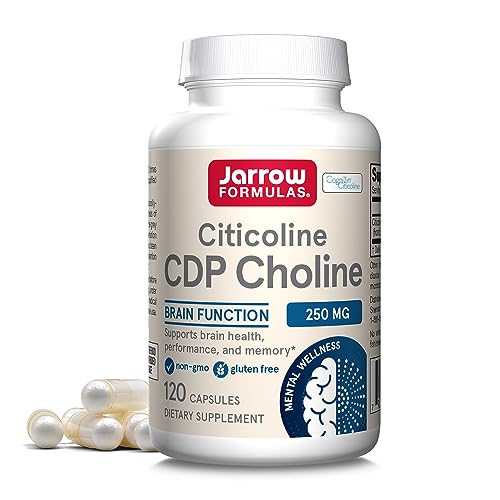
Based on the labeled dose options for Jarrow Formulas Citicoline 250mg and the published 120-count bottle at $44.94.
Open the full dosage & cost calculator →
Estimate only – based on the current listed price of the 120-count Jarrow Formulas Citicoline 250mg bottle. Actual Amazon price can change; check the live price before buying.
Why no height/weight input? Unlike per-kg supplements (creatine, protein), Citicoline (CDP-Choline) has no published bodyweight-adjusted dosing in the research behind it. This calculator doesn't fabricate a per-kg formula that doesn't exist in the literature.
Get Jarrow Formulas Citicoline 250mg on Amazon(paid link) As an Amazon Associate we earn from qualifying purchases.
Safety Profile and Potential Side Effects
Citicoline is generally considered safe and well-tolerated at commonly recommended dosages. The incidence of adverse effects in clinical trials is low and usually mild.
Common and Rare Side Effects
The most frequently reported side effects include mild gastrointestinal issues such as stomach upset, nausea, diarrhea, or constipation. Headaches have also been occasionally reported. These effects are typically transient and resolve on their own.
More serious side effects are rare. Some individuals may experience transient hypotension (low blood pressure) or bradycardia (slow heart rate) at very high intravenous doses, but these are not typically observed with oral supplementation at standard dosages.

Interactions and Contraindications
Citicoline’s interaction profile is not empty, and one interaction deserves naming directly. Citicoline increases dopamine synthesis and inhibits dopamine uptake, and a systematic review of citicoline as adjunctive therapy in Parkinson’s disease found that adding it allowed levodopa doses to be reduced by up to 50% while symptom control was maintained.[5] Anyone taking levodopa or another dopaminergic medication should therefore treat citicoline as a dose-relevant addition and involve their prescriber, rather than adding it unsupervised on top of an existing dose. Caution also applies alongside cholinergic drugs such as donepezil or rivastigmine, and alongside other choline-containing supplements, where the concern is excess cholinergic activity. Individuals with a history of allergic reactions to citicoline or its components should avoid it.
Pregnant or breastfeeding women, and individuals with pre-existing medical conditions, should consult a healthcare professional before starting any new supplement, including citicoline.
Citicoline vs. Other Choline Sources: A Comparison
While citicoline is a potent source of choline, it is not the only one. Understanding how it compares to other common choline supplements can help contextualize its unique benefits.
| Choline Source | Key Characteristics | Primary Benefits | Typical Dosage Range |
|---|---|---|---|
| Citicoline (CDP-Choline) | Provides both choline and cytidine (converts to uridine); crosses blood-brain barrier efficiently. | Enhances acetylcholine synthesis, supports neuronal membrane repair, improves attention and focus. | 250 mg – 1000 mg daily |
| Alpha-GPC (Alpha-glycerylphosphorylcholine) | High bioavailability, directly delivers choline to the brain; also a precursor for phospholipids. | Strong acetylcholine precursor, supports power output in athletes, memory support. | 300 mg – 600 mg daily |
| Choline Bitartrate | Common, cost-effective choline salt; lower bioavailability to the brain compared to citicoline/Alpha-GPC. | General choline deficiency prevention, liver support, basic neurotransmitter support. | 500 mg – 2000 mg daily |
| Lecithin (Phosphatidylcholine) | Naturally occurring phospholipid, dietary source of choline; less efficient for direct brain choline delivery. | Dietary choline source, supports liver health, emulsifier. | 1200 mg – 3600 mg daily (as lecithin) |
Citicoline’s unique advantage lies in its dual action: providing choline for acetylcholine synthesis and cytidine for uridine and phospholipid production. This makes it a comprehensive choice for supporting both the functional and structural aspects of brain health.
Choosing a Quality Citicoline Supplement (e.g., Cognizin)
When selecting a citicoline supplement, quality and purity are paramount. The market includes various brands, but not all are created equal. Look for products that clearly state their citicoline content and are manufactured in facilities adhering to Good Manufacturing Practices (GMP).

Cognizin is a patented, branded form of citicoline that has been used in many of the clinical studies demonstrating citicoline’s benefits. Opting for supplements containing Cognizin ensures you are getting a well-researched and high-quality form of citicoline. This branded ingredient is standardized for purity and consistency, offering peace of mind regarding the product’s integrity.
Where to Find Quality Citicoline Supplements
When searching for citicoline supplements, particularly those containing Cognizin, reputable online retailers and health stores are good starting points. Look for products that specify “Cognizin Citicoline” on their label to ensure you are getting the clinically studied form.
On platforms like Amazon, you can search for Cognizin Citicoline capsules, CDP Choline powder, or brain health supplements with Cognizin. Always check product reviews and third-party testing certifications if available, to ensure transparency and quality.
Conclusion: Informed Decisions for Brain Health
Citicoline (CDP-choline) offers a compelling profile as a supplement for cognitive support and brain health. Based on current research, a daily dosage of 250 mg to 500 mg is a common starting point for healthy adults seeking cognitive enhancement. For older adults or specific applications, dosages up to 1000 mg daily have been explored.
It is generally well-tolerated with a low incidence of mild side effects. Always prioritize quality supplements, such as those containing Cognizin, and consult with a healthcare professional, especially if you have underlying health conditions or are taking other medications. Making informed choices about dosage and product quality is crucial for safely and effectively supporting your brain health journey.

Frequently Asked Questions (FAQ)
What is the best time of day to take citicoline?
Most individuals take citicoline in the morning to support focus and attention throughout the day. If taking a higher dose, splitting it into morning and early afternoon doses can be beneficial.
Can I take citicoline every day long-term?
Citicoline is generally considered safe for daily use over several months. While long-term studies beyond a year are limited, current evidence suggests good tolerability. Some individuals prefer to cycle their supplementation (e.g., 2-3 months on, 1 month off).
Are there any foods naturally rich in citicoline?
Citicoline itself is not found as a distinct nutrient in foods. However, foods rich in choline, such as eggs, beef liver, soybeans, and certain fish, provide precursors that the body can use to synthesize citicoline endogenously. Supplementation provides a direct and concentrated source.
Can citicoline be stacked with other nootropics?
Yes, citicoline is often combined with other nootropics, such as piracetam or L-theanine, in “stacks” to potentially enhance synergistic effects. However, always introduce new supplements one at a time to assess individual reactions and consult a healthcare professional, especially when combining multiple compounds.
How long does it take to feel the effects of citicoline?
The timeline for feeling effects can vary. Some individuals report subtle improvements in focus or mental clarity within a few days to a week. For more pronounced or sustained benefits, particularly in areas like memory and attention, consistent supplementation for 28 days to 12 weeks, as seen in clinical trials, may be necessary.
Is there a difference between citicoline and CDP-choline?
No, citicoline and CDP-choline are two names for the exact same compound. CDP-choline is the abbreviation for cytidine 5′-diphosphocholine, which is chemically known as citicoline. The terms are interchangeable.
References
- The Effect of Citicoline Supplementation on Motor Speed and Attention in Adolescent Males. Journal of Attention Disorders (2019 (online 2015)). https://pubmed.ncbi.nlm.nih.gov/26179181/
- Improved Attentional Performance Following Citicoline Administration in Healthy Adult Women. Food and Nutrition Sciences 3:769-773 (not indexed in PubMed) (2012). https://doi.org/10.4236/fns.2012.36103
- Cytidinediphosphocholine (CDP-choline) for cognitive and behavioural disturbances associated with chronic cerebral disorders in the elderly. Cochrane Database of Systematic Reviews (2005). https://pubmed.ncbi.nlm.nih.gov/15846601/
- Is Citicoline Effective in Preventing and Slowing Down Dementia? A Systematic Review and a Meta-Analysis. Nutrients (2023). https://pubmed.ncbi.nlm.nih.gov/36678257/
- Citicoline as Adjuvant Therapy in Parkinson’s Disease: A Systematic Review. Clinical Therapeutics (2021). https://pubmed.ncbi.nlm.nih.gov/33279231/
- Citicoline for treating people with acute ischemic stroke. Cochrane Database of Systematic Reviews (2020). https://pubmed.ncbi.nlm.nih.gov/32860632/
These statements have not been evaluated by the FDA. This product is not intended to diagnose, treat, cure, or prevent any disease.
These statements have not been evaluated by the Food and Drug Administration. This information is not intended to diagnose, treat, cure, or prevent any disease. Content is for informational purposes only and is not medical advice; consult a qualified healthcare provider before starting any supplement. As an Amazon Associate we earn from qualifying purchases.
