Citicoline supplement labels vary widely, some capsules contain 250 mg, others 500 mg, and a smaller number go as high as 1,000 mg per serving. Rather than guessing which is “best,” it helps to look directly at what doses researchers have actually tested and what outcomes those doses produced.
This article compares citicoline dosing across the clinical trial literature, from cognitive-support studies in healthy adults to higher-dose neuroprotection research in stroke patients. Nothing here constitutes medical advice or a personalized dosing recommendation. Citicoline has not been approved by the FDA to diagnose, treat, cure, or prevent any disease.
Key Takeaways
- The 250-500 mg/day range is the most extensively studied for general cognitive and attentional support in healthy and aging adults.
- A dose-response stroke trial found 500 mg and 2,000 mg/day both outperformed placebo, but the 1,000 mg group did not reach significance, evidence against a simple more-is-better relationship [1].
- In healthy women aged 40-60, both 250 mg and 500 mg daily doses improved attentional test performance after 28 days versus placebo [2].
- A 500 mg/day, 12-week trial in older adults with age-associated memory impairment improved episodic and composite memory scores [3].
- Doses above 1,000 mg/day have mostly been studied in acute clinical settings like stroke, not general wellness use, and should not be assumed to apply outside that context.
The Stroke Dose-Response Trial: A Non-Linear Result
The most direct dose-comparison data on citicoline comes from a 1997 trial in acute ischemic stroke patients. Two hundred fifty-nine patients were randomized to placebo or one of three oral citicoline doses, 500 mg, 1,000 mg, or 2,000 mg daily, for six weeks, with functional recovery assessed via the Barthel Index at 12 weeks [1]. If citicoline followed a simple dose-response curve, higher doses should have produced proportionally better outcomes.
That is not what happened. Both the 500 mg and 2,000 mg groups showed statistically significant improvement over placebo, but the 1,000 mg group did not reach significance [1]. This kind of irregular, non-monotonic dose-response pattern shows up periodically in nootropic and neuroprotective compound research and is one reason researchers caution against assuming “more milligrams equals more benefit” for citicoline specifically.
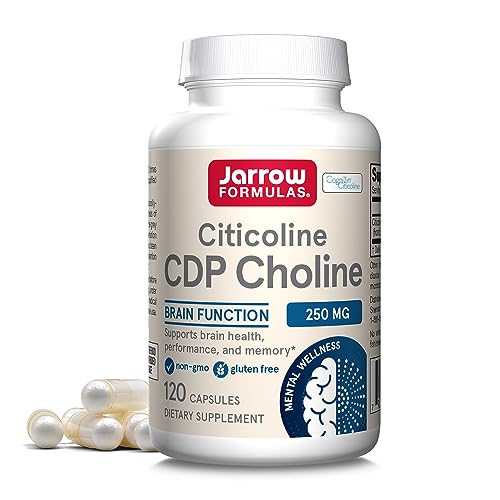
250mg vs 500mg: Attentional Performance in Healthy Adults
For the general cognitive-support use case most supplement buyers care about, the most relevant head-to-head dose comparison comes from a study of 60 healthy women aged 40 to 60, randomized to 250 mg/day citicoline, 500 mg/day citicoline, or placebo for 28 days, with attention measured via the Continuous Performance Test II [2]. Both active-dose groups outperformed placebo on error rates, and interestingly the 250 mg group showed statistically significant reductions in both omission and commission errors, while the 500 mg group reached significance on commission errors and trended toward significance on omission errors [2].
This is a useful data point for anyone assuming that a 500 mg product must be inherently superior to a 250 mg one. In this particular trial population and outcome measure, the lower dose performed at least as well.
500mg in Older Adults: The Memory Data
Separately, a 2021 randomized, double-blind, placebo-controlled trial specifically tested 500 mg/day citicoline over 12 weeks in adults aged 50 to 85 with age-associated memory impairment. Participants receiving citicoline showed significantly greater improvement in episodic memory and composite memory scores compared to placebo [3]. This trial did not include a lower-dose comparison arm, so it cannot say whether 250 mg would have produced a similar effect in this specific older population, but it does establish 500 mg/day as an effective, well-tolerated dose for this use case over a meaningful treatment duration.

What About Doses Above 1,000mg?
Doses at or above 1,000 mg/day appear almost exclusively in acute clinical research, primarily stroke and traumatic brain injury trials, rather than general wellness or cognitive-support studies in healthy populations. The stroke dose-response trial’s finding that 2,000 mg outperformed 1,000 mg, while 500 mg also outperformed 1,000 mg, underscores that high-dose citicoline research operates in a different context with different goals (acute neuroprotection after injury) than the lower-dose cognitive-support literature most supplement users are interested in [1]. There is no strong evidence base supporting doses above roughly 500 mg/day for routine, non-clinical cognitive maintenance.

A Practical Starting Point
Based on the available trial data, 250 to 500 mg/day represents the best-supported range for general cognitive and attentional support in adults, with meaningful benefits documented at both ends of that range depending on the population and outcome studied. Starting at the lower end and evaluating individual response before considering any increase is a reasonable, conservative approach. Anyone with an existing medical condition, taking prescription medications (particularly those affecting acetylcholine, such as cholinesterase inhibitors), or considering doses outside the well-studied range should consult a healthcare provider first.
Frequently Asked Questions
What is the most commonly studied citicoline dose?
The 250 to 500 mg/day range appears most frequently across the human trial literature, including a 12-week trial using 500 mg/day in older adults with age-associated memory impairment that found improved episodic and composite memory versus placebo [3].
Is a higher dose always better?
No. A dose-response trial in acute ischemic stroke patients tested 500 mg, 1,000 mg, and 2,000 mg daily and found both the 500 mg and 2,000 mg groups showed significant improvement over placebo, while the 1,000 mg group did not reach statistical significance [1]. This non-linear pattern is a reminder that more milligrams does not automatically translate to a proportionally larger effect.
Does 250mg do anything on its own?
In a placebo-controlled trial in healthy women aged 40 to 60, both a 250 mg/day dose and a 500 mg/day dose reduced attentional errors on a standardized computer test relative to placebo after 28 days, with the 250 mg group showing slightly stronger effects on some measures [2].
What dose is used for stroke research versus general cognitive support?
Stroke research has tested considerably higher doses, up to 2,000 mg/day [1], reflecting the acute neuroprotective goal in that context. Cognitive-support research in healthy or aging populations has clustered much lower, typically 250 to 500 mg/day [2] [3]. These are different clinical questions and the doses should not be assumed interchangeable.

Should I start at the lowest studied dose?
Starting at the lower end of the studied range (250 mg/day) and observing individual response before considering an increase is a reasonable, conservative approach supported by the trial data showing meaningful effects even at this dose [2]. Anyone considering doses above what has been studied in healthy populations should discuss this with a healthcare provider first.

References
- Citicoline Stroke Study Group. A randomized dose-response trial of citicoline in acute ischemic stroke patients. Neurology (1997). PMID 9305321
- McGlade E et al. Improved Attentional Performance Following Citicoline Administration in Healthy Adult Women. Food and Nutrition Sciences (2012). DOI 10.4236/fns.2012.36103
- Nakazaki E et al. Citicoline and Memory Function in Healthy Older Adults: A Randomized, Double-Blind, Placebo-Controlled Clinical Trial. Journal of Nutrition (2021). PMID 33978188
These statements have not been evaluated by the FDA. This product is not intended to diagnose, treat, cure, or prevent any disease. This article is for informational purposes only and is not a substitute for professional medical advice. As an Amazon Associate we earn from qualifying purchases.
These statements have not been evaluated by the Food and Drug Administration. This information is not intended to diagnose, treat, cure, or prevent any disease. Content is for informational purposes only and is not medical advice; consult a qualified healthcare provider before starting any supplement. As an Amazon Associate we earn from qualifying purchases.
