Citicoline — also called CDP-choline or cytidine 5′-diphosphocholine — is a naturally occurring compound found in small amounts in foods such as eggs and organ meats. After oral ingestion it is cleaved into choline and cytidine, which the body then uses independently: choline feeds into the synthesis of the neurotransmitter acetylcholine and the structural membrane phospholipid phosphatidylcholine, while cytidine is converted to uridine, a building block for RNA and additional membrane components. This dual-pathway activity has made citicoline a popular supplement for cognitive support.
Interest in long-term daily use is growing, but questions about sustained safety deserve a careful look. This article explains the proposed mechanisms, reviews what clinical data exist on tolerability over time, and is honest about where the evidence is still thin. Nothing here constitutes medical advice, and citicoline is not approved by the FDA to diagnose, treat, cure, or prevent any disease.
Key Takeaways
- Citicoline splits into choline and cytidine after absorption, supporting acetylcholine synthesis, phospholipid membrane repair, and potentially dopamine receptor density — all proposed mechanisms, not proven clinical outcomes in healthy adults.
- At 250–500 mg per day, short-to-medium term trials report mild and infrequent side effects, primarily transient GI discomfort or headache, especially at higher doses.
- True long-term safety data — years of daily use in healthy people — does not yet exist; current confidence is based on extrapolation from shorter clinical trials and citicoline’s endogenous status.
- People with cholinergic sensitivity, mood disorders, or who take cholinergic medications should consult a clinician before starting daily citicoline.
- Starting low (250 mg), monitoring your individual response, and involving a healthcare provider in any long-term supplementation plan are the most evidence-aligned approaches available.
How Citicoline Works in the Body
When citicoline is absorbed, it splits rapidly in the intestinal wall and liver. The choline fraction enters circulation and crosses the blood-brain barrier, where it can be used by choline acetyltransferase — an enzyme that combines choline with acetyl-CoA to make acetylcholine. Adequate acetylcholine availability supports memory encoding and attentional signaling via muscarinic and nicotinic receptors.
The cytidine fraction converts to uridine in the bloodstream. Uridine participates in the Kennedy pathway, which assembles phosphatidylcholine into neuronal cell membranes. Researchers have proposed that by supporting membrane phospholipid synthesis, citicoline may help preserve the structural integrity of neurons and facilitate membrane repair after injury or oxidative stress.
A third proposed mechanism involves dopaminergic signaling. Animal and early human data suggest that citicoline may upregulate dopamine receptor density in the striatum, potentially explaining observations around motivation and processing speed reported in some participants. These mechanisms are plausible and biochemically grounded, but it is important to note that establishing a mechanism is not the same as proving a clinical benefit in healthy adults.
What 'Long-Term Use' Actually Means in the Research
Most human clinical trials on citicoline run for 90 days or less, with a smaller number extending to six months. A handful of stroke-rehabilitation and age-related cognitive decline studies have followed participants for up to twelve months.[1][2][3] Truly long-term data — spanning several years of continuous daily use in otherwise healthy people — does not yet exist in the published literature.
The dose range across these studies is broad, from as low as 250 mg per day up to 2,000 mg per day in neurological populations.[4] The doses most commonly evaluated for general cognitive support fall between 250 and 500 mg daily. When evaluating any safety claim about long-term citicoline use, it is worth asking which dose, which population, and over what time frame the data were gathered, because these details vary considerably across trials.

Tolerability Profile: What Side Effects Have Been Reported?
At doses of 250–500 mg per day, clinical trials have consistently reported an excellent tolerability profile.[5] The most commonly noted adverse effects are mild and transient: gastrointestinal discomfort such as nausea or loose stools, and occasional headache. These effects appear more often at higher doses or in individuals who are particularly sensitive to cholinergic stimulation — meaning people whose systems respond strongly to elevated acetylcholine activity.
Cholinergic sensitivity is worth understanding before committing to daily use. Some individuals experience brain fog, low mood, or unusual fatigue when choline intake rises significantly. This is sometimes called ‘choline syndrome’ in anecdotal reports, and it likely reflects an imbalance between cholinergic and dopaminergic tone rather than toxicity. If such symptoms emerge, reducing the dose or cycling off temporarily is a reasonable first step.
There are no well-documented reports of organ toxicity, dependency, or withdrawal associated with citicoline at supplemental doses in the peer-reviewed literature. However, absence of reported harm over short to medium trial periods should not be read as confirmation of complete safety over a decade of daily use — that data simply does not exist yet.[6]
Populations Who Should Exercise Additional Caution
Pregnant and breastfeeding individuals are routinely excluded from citicoline trials, so safety data in these populations is absent. While choline is an essential nutrient during pregnancy and adequate intake is critical for fetal brain development, supplementing with high-dose isolated citicoline is not the same as dietary choline, and the risk-benefit calculation has not been studied in this context.
People taking medications that affect cholinergic transmission — such as certain drugs used in Alzheimer’s management, myasthenia gravis, or organophosphate-related conditions — should consult a clinician before adding citicoline. Stacking additional cholinergic activity on top of these medications could amplify side effects or alter drug dynamics in unpredictable ways.
Individuals with bipolar disorder or a history of mania should approach citicoline with caution, as case reports have noted mood activation associated with high-dose choline supplementation. This is not a well-characterized risk from controlled trials, but it is worth flagging given the theoretical mechanism.
The Evidence Gap: What We Don't Know Yet
The honest answer to the question ‘is citicoline safe for years of daily use?’ is that the data to answer it definitively do not yet exist. What we have are short-to-medium term trials — mostly in clinical populations recovering from stroke, traumatic brain injury, or age-related cognitive decline — that show a consistently benign side-effect profile. Extrapolating those findings to a healthy 30-year-old taking 500 mg every day for five years requires assumptions that no study has yet tested.


It is also worth noting that citicoline research suffers from some common limitations in the supplement field: small sample sizes, variable outcome measures, industry funding in some trials, and limited replication.[6] Well-powered, independent, long-duration studies in healthy adults are needed before strong safety conclusions can be drawn.
That said, the pharmacological profile of citicoline — a compound the body already synthesizes endogenously, with metabolites that are themselves normal dietary and physiological constituents — gives researchers some a-priori reason for confidence about its safety ceiling. The risk is likely low, but ‘likely low’ and ‘proven safe’ are not the same statement.
Practical Considerations for Daily Use
If you decide to take citicoline daily, starting at the lower end of the studied range — 250 mg — and assessing your personal response before increasing is a sensible approach. Some people find that taking it in the morning reduces the small risk of sleep disruption associated with stimulating neurotransmitter precursors.
Dietary context matters. If you already consume a choline-rich diet (eggs, liver, fish, legumes), you are adding citicoline on top of an existing baseline. Monitoring for signs of cholinergic excess — unusual fatigue, muscle achiness, vivid or excessive dreams, GI changes — gives you useful feedback about your individual tolerance.
Periodic breaks, such as cycling five days on and two days off or taking a full week off every few months, are sometimes recommended by practitioners as a precaution until longer-term data are available. There is no clinical evidence that cycling is necessary, but it is a low-cost hedge against unknown accumulation effects.
🛒 Where to Buy Citicoline
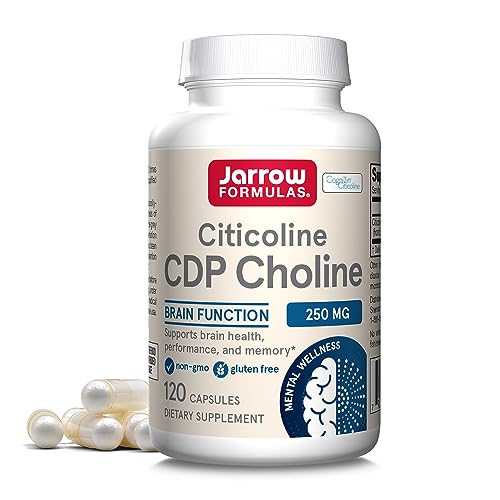
- Jarrow Formulas Cognizin CDP-Choline 250mgLab-tested / studied
capsules, 250 mg citicoline (Cognizin) per capsule, 60 capsules — The benchmark Cognizin-branded product; widely stocked, non-GMO, third-party tested; the go-to reference for price comparisons across the category. - NOW Foods CDP-Choline 300mg
capsules, 300 mg CDP-choline per vegetarian capsule, 60 capsules — 300mg per capsule at a competitive price; GMP-certified, non-GMO; consistently passes independent lab tests; ideal entry point for first-time buyers. - Nutricost Citicoline (CDP-Choline) 500mg
capsules, 500 mg citicoline per capsule, 60 capsules — High-dose option suited to experienced users; GMP-certified facility; budget-friendly; third-party tested; allows easy split-dose regimen at 250mg twice daily. - Double Wood Supplements Citicoline (CDP-Choline) 300mg
capsules, 300 mg CDP-choline per capsule, 60 capsules — Certificates of analysis available; US-manufactured; well-regarded in nootropics forums for consistent potency and transparent testing practices.
As an Amazon Associate we earn from qualifying purchases. Citicoline quality comes down to label accuracy and independent verification. Choose a product that states the exact milligrams of citicoline per serving rather than hiding it inside a proprietary blend, and prefer finished-product certification from NSF, USP or Informed Sport — Cognizin is the branded form named in most published trials, but an independently certified generic carries the same active molecule.

A Note on the Evidence
The evidence base for citicoline is more developed than for most cognitive supplements, but it remains largely short-term and drawn from clinical populations rather than healthy adults using it preventively over years; anyone with a medical condition, anyone taking prescription medications that affect cholinergic or dopaminergic systems, and anyone who is pregnant or breastfeeding should speak with a qualified healthcare provider before starting or continuing daily citicoline use.
Frequently Asked Questions
Is citicoline safe to take every day?
Based on trials lasting up to twelve months, citicoline at 250–500 mg per day has a consistently favorable tolerability profile with mostly mild, transient side effects. However, daily use over several years in healthy individuals has not been studied in controlled trials, so ‘safe for everyone indefinitely’ is a stronger claim than the current evidence supports.

Can you build a tolerance to citicoline?
Tolerance in the classical sense — needing progressively higher doses for the same effect — has not been documented in clinical trials for citicoline. There are also no established withdrawal symptoms associated with stopping its use. That said, individual neurochemistry varies, and anecdotal reports of diminishing returns exist; periodic cycling is sometimes suggested as a precaution, though evidence for its necessity is lacking.
What are the most common side effects of citicoline?
The most commonly reported adverse effects are mild gastrointestinal discomfort (nausea, loose stools) and transient headache. These tend to occur more frequently at doses above 500 mg per day or in people who are sensitive to cholinergic stimulation. Reducing the dose typically resolves these effects.
Is citicoline the same as choline?
No. Citicoline is a distinct molecule — cytidine 5′-diphosphocholine — that contains choline as one of its components. After ingestion it also releases cytidine, which converts to uridine. This dual-pathway activity is what differentiates citicoline pharmacologically from taking choline bitartrate or alpha-GPC, though all three raise plasma choline levels.
Can I take citicoline with other supplements?
Citicoline is commonly combined with other nootropic supplements without documented interactions in the literature. However, stacking multiple cholinergic supplements (for example, citicoline plus alpha-GPC plus huperzine A) substantially increases cholinergic load and may heighten the risk of headache, fatigue, or mood effects. Combining one cholinergic source at a time is a more conservative approach.
Is citicoline FDA-approved?
No. Citicoline is sold in the United States as a dietary supplement and has not been approved by the FDA to diagnose, treat, cure, or prevent any disease. It is approved as a prescription drug in some European and Asian countries for post-stroke rehabilitation, but that regulatory status does not apply to over-the-counter supplement use in the US.
References
- Alvarez-Sabín J, Ortega G, Jacas C, et al. Long-term treatment with citicoline may improve poststroke vascular cognitive impairment. Cerebrovasc Dis (2013). PMID 23406981
- Cohen RA, Browndyke JN, Moser DJ, et al. Long-term citicoline (cytidine diphosphate choline) use in patients with vascular dementia: neuroimaging and neuropsychological outcomes. Cerebrovasc Dis (2003). PMID 12865605
- Hall DA, Robertson EE, Leehey M, et al. Open-label pilot clinical trial of citicoline for fragile X-associated tremor/ataxia syndrome (FXTAS). PLoS One (2020). PMID 32053612
- Clark WM, Wechsler LR, Sabounjian LA, et al. A phase III randomized efficacy trial of 2000 mg citicoline in acute ischemic stroke patients. Neurology (2001). PMID 11706098
- Nakazaki E, Mah E, Sanoshy K, et al. Citicoline and Memory Function in Healthy Older Adults: A Randomized, Double-Blind, Placebo-Controlled Clinical Trial. J Nutr (2021). PMID 33978188
- Martí-Carvajal AJ, Valli C, Martí-Amarista CE, et al. Citicoline for treating people with acute ischemic stroke. Cochrane Database Syst Rev (2020). PMID 32860632
These statements have not been evaluated by the Food and Drug Administration. This information is not intended to diagnose, treat, cure, or prevent any disease. Content is for informational purposes only and is not medical advice; consult a qualified healthcare provider before starting any supplement. As an Amazon Associate we earn from qualifying purchases.
