Citicoline (cytidine 5′-diphosphocholine, or CDP-choline) has become one of the more studied choline sources in the nootropic space, partly because it serves a dual function: it supplies choline for acetylcholine synthesis and provides cytidine, which the body converts to uridine, a building block for neuronal membrane phospholipids. That dual action makes it an appealing foundation for stacks targeting focus, memory encoding, or cognitive resilience.
Stacking citicoline with other compounds is popular because choline donors often work synergistically with substances that increase choline demand—most famously the racetam class—or complement it through entirely different mechanisms. This article walks through the most commonly discussed citicoline stacks, explains the proposed biology behind each pairing, and is honest about where the evidence is robust, where it is preliminary, and where it is essentially absent.
Key Takeaways
- Citicoline supplies choline for acetylcholine synthesis and cytidine for uridine production, supporting both neurotransmitter function and neuronal membrane integrity through two distinct pathways.
- The citicoline-plus-racetam stack is the most historically discussed combination; the rationale is mechanistically coherent, but controlled human trials comparing the combination to monotherapy in healthy adults are limited.
- Caffeine plus L-theanine is the best-supported cognitive stack in human trials; adding citicoline to this pair is popular and pharmacologically rational given complementary mechanisms.
- Shilajit’s proposed mitochondrial energy support via fulvic acids and dibenzo-alpha-pyrones makes it an intriguing complement to citicoline’s cholinergic demands, but direct combination trials do not yet exist.
- Quality control matters significantly for shilajit; always choose products with third-party testing for heavy metals and standardized fulvic acid content.
How Citicoline Works: A Plain-Language Mechanism Overview
When you ingest citicoline, intestinal phosphatases cleave it into choline and cytidine. Choline crosses the blood-brain barrier and enters two main pathways: it is acetylated by choline acetyltransferase into acetylcholine, the neurotransmitter central to attention and memory consolidation, and it feeds the CDP-choline pathway to regenerate phosphatidylcholine, the dominant phospholipid in neuronal cell membranes.[2]
Cytidine, meanwhile, is converted peripherally to uridine. Uridine contributes to the Kennedy pathway for membrane phospholipid synthesis and has been proposed to support synaptic density by providing substrate for neurite outgrowth. Separately, preclinical and early human data suggest citicoline may upregulate dopamine receptor density in the striatum, which could relate to the motivational benefits some users report, though this mechanism is not yet confirmed in large controlled trials.
Clinical trials using 250–500 mg per day report good tolerability.[1] Mild gastrointestinal discomfort or a transient headache can occur, especially at higher doses or in people who are sensitive to cholinergic stimulation. These effects are typically short-lived and dose-dependent.
Citicoline + Racetams: The Classic Stack
The pairing of citicoline with a racetam—piracetam being the original, with aniracetam, oxiracetam, and phenylpiracetam as later variants—is arguably the most cited combination in the nootropic community. The rationale is mechanistic: racetams are thought to increase the turnover rate of acetylcholine in the synaptic cleft and may sensitize acetylcholine receptors. Greater cholinergic demand creates a higher need for choline substrate, and supplementing citicoline is proposed to prevent the ‘choline headache’ some users report when taking racetams alone.
Piracetam is the best-studied racetam and holds a long research history in age-related cognitive decline and post-stroke cognition in European settings, though it is not approved as a drug in the United States. The synergy with choline donors is biologically plausible and widely reported anecdotally, but direct head-to-head controlled trials comparing citicoline-plus-racetam against either agent alone in healthy adults are limited. Users interested in this stack should be aware that most racetams are unregulated dietary compounds in the US and their long-term safety profiles in healthy individuals are not well characterized.
A practical starting point in the literature-adjacent community is 250 mg citicoline paired with a moderate racetam dose, taken with a fat-containing meal since some racetams are fat-soluble. Adjusting based on individual response is prudent.
Citicoline + Caffeine and L-Theanine: The Accessible Everyday Stack
Caffeine and L-theanine is the single most evidence-supported nootropic pairing in the cognitive enhancement literature, with multiple small controlled trials in healthy adults showing improvements in sustained attention, reaction time, and working memory with the combination compared to either compound alone. Adding citicoline to this pair is a popular next step.
The proposed logic is that caffeine’s adenosine antagonism provides acute alertness, L-theanine modulates excitatory tone and takes the edge off caffeine-induced jitteriness, and citicoline supports the cholinergic substrate needed to convert arousal into efficient encoding and recall. Because caffeine and L-theanine operate on adenosine and glutamate/GABA pathways respectively, and citicoline operates primarily through cholinergic and membrane phospholipid mechanisms, the combination is thought to have additive rather than overlapping effects.
This is one of the more beginner-friendly stacks because all three components are widely available, well-tolerated at typical doses, and have a meaningful body of human safety data. Typical ranges discussed in the literature are 100 mg caffeine paired with 200 mg L-theanine; citicoline is added at 250–500 mg. Individuals sensitive to caffeine should start at the lower end or time intake to avoid disrupting sleep.
Citicoline + Lion's Mane Mushroom: Targeting Neuroplasticity
Lion’s mane (Hericium erinaceus) has attracted research interest for its hericenones and erinacines—bioactive compounds that stimulate Nerve Growth Factor (NGF) synthesis in cell and animal models. NGF is critical for the survival and maintenance of cholinergic neurons in the basal forebrain, which are the same neurons whose activity citicoline supports through choline supply.
The theoretical synergy is appealing: citicoline provides the substrate to keep cholinergic neurons firing efficiently today, while lion’s mane may, over a longer time horizon, support the structural integrity of those same neurons through NGF-mediated pathways. Human trial evidence for lion’s mane in cognitive settings is limited to small studies, and the doses and extract standards vary considerably across commercial products, making extrapolation difficult.
This combination is best understood as a longer-arc, lower-evidence stack compared to caffeine plus L-theanine. Those exploring it should look for lion’s mane products standardized for beta-glucan content or using hot-water extraction and should set realistic expectations: any neuroplasticity-adjacent effects are likely subtle and require consistent use over weeks to months.
Citicoline + Shilajit: An Emerging Combination Worth Understanding
Shilajit is a tar-like resinous substance found predominantly in Himalayan and Central Asian mountain rock formations, formed over centuries from the compression of organic plant matter. Its primary bioactive components include fulvic acid, humic acids, and dibenzo-alpha-pyrones (DBPs). Fulvic acid is proposed to act as an electron shuttle that supports mitochondrial electron transport chain function; dibenzo-alpha-pyrones are thought to protect the mitochondrial CoQ10-dependent energy pathway from degradation.

The rationale for pairing shilajit with citicoline centers on complementary metabolic support. Acetylcholine synthesis and phosphatidylcholine turnover are energy-intensive processes. If shilajit’s fulvic acid and DBP components genuinely support mitochondrial ATP production—as suggested by early in vitro and animal work—they could theoretically provide a more favorable cellular energy environment in which citicoline’s cholinergic and membrane-building actions operate more efficiently. This is a biologically plausible hypothesis rather than a demonstrated synergy; direct human combination trials do not yet exist.
It is important to note that most shilajit research is early-stage, often preclinical, and conducted in small populations. Quality control is a meaningful concern in the shilajit market: products vary widely in purification, heavy metal content, and standardization. Consumers should prioritize products with third-party testing for heavy metals and authenticity. Purified shilajit extract standardized for fulvic acid content is the form most commonly used in research settings.
Dosing Principles and Practical Stack Design
A useful framing for citicoline stack design is to distinguish between the acute-alertness layer (caffeine, L-theanine), the cholinergic substrate layer (citicoline), and the longer-arc structural or metabolic layer (lion’s mane, shilajit, or other adaptogens). These layers operate through sufficiently distinct mechanisms that stacking across them is unlikely to produce redundancy and may produce additive benefit, though direct combination studies in healthy adults are scarce.
Clinical tolerability data for citicoline centers on the 250–500 mg per day range taken once or twice daily. Most experienced practitioners suggest starting at 250 mg to assess individual sensitivity before increasing. Racetam co-administration is sometimes accompanied by recommendations to increase choline intake, though the specific ratio varies by individual and racetam used—listen to your body and back off if you notice signs of cholinergic excess such as a dull headache, brain fog, or GI upset.
Cycling protocols are popular in the nootropic community (for example, five days on, two days off) to avoid potential desensitization, but there is no controlled human data directly comparing cycling versus continuous dosing for cognitive outcomes. This remains a domain of community experimentation rather than established science.
🛒 Where to Buy Citicoline
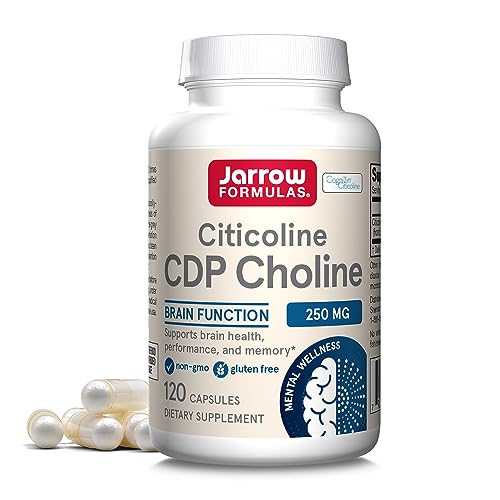
- Jarrow Formulas Cognizin CDP-Choline 250mgLab-tested / studied
capsules, 250 mg citicoline (Cognizin) per capsule, 60 capsules — The benchmark Cognizin-branded product; widely stocked, non-GMO, third-party tested; the go-to reference for price comparisons across the category. - NOW Foods CDP-Choline 300mg
capsules, 300 mg CDP-choline per vegetarian capsule, 60 capsules — 300mg per capsule at a competitive price; GMP-certified, non-GMO; consistently passes independent lab tests; ideal entry point for first-time buyers. - Nutricost Citicoline (CDP-Choline) 500mg
capsules, 500 mg citicoline per capsule, 60 capsules — High-dose option suited to experienced users; GMP-certified facility; budget-friendly; third-party tested; allows easy split-dose regimen at 250mg twice daily. - Double Wood Supplements Citicoline (CDP-Choline) 300mg
capsules, 300 mg CDP-choline per capsule, 60 capsules — Certificates of analysis available; US-manufactured; well-regarded in nootropics forums for consistent potency and transparent testing practices.
As an Amazon Associate we earn from qualifying purchases. Citicoline quality comes down to label accuracy and independent verification. Choose a product that states the exact milligrams of citicoline per serving rather than hiding it inside a proprietary blend, and prefer finished-product certification from NSF, USP or Informed Sport — Cognizin is the branded form named in most published trials, but an independently certified generic carries the same active molecule.
A Note on the Evidence
The evidence base for most citicoline stack combinations in healthy adults is limited, and no stack discussed here has been approved by the FDA to treat or prevent any condition; this article is informational only and does not constitute medical advice. Individuals who are pregnant, nursing, taking prescription medications, or managing a health condition should consult a qualified healthcare provider before adding any of these supplements.
Frequently Asked Questions
What is a citicoline nootropic stack?
A citicoline nootropic stack is a combination of citicoline with one or more other supplements chosen to work through complementary mechanisms. Common additions include racetams (which increase cholinergic demand that citicoline can help meet), caffeine and L-theanine (for acute alertness with distinct pathways), lion’s mane (for proposed NGF support), or shilajit (for proposed mitochondrial energy support). The goal is to achieve additive effects that a single compound might not provide alone.
Do I need citicoline if I already take alpha-GPC?
Alpha-GPC and citicoline are both choline donors, but they differ beyond that: citicoline also provides cytidine, which converts to uridine and contributes to phospholipid synthesis through the Kennedy pathway. Alpha-GPC delivers a higher proportion of bioavailable choline per milligram and may raise plasma choline levels more acutely. The two are not identical, and some users prefer citicoline for the uridine component; others prefer alpha-GPC for racetam stacks where maximizing choline availability is the primary goal. Taking both simultaneously is generally considered redundant.
Is citicoline safe to take daily?
Clinical trials at 250–500 mg per day report an excellent tolerability profile over the periods studied, with mild GI discomfort or transient headache as the most commonly noted side effects, particularly at higher doses. Long-term safety data in healthy adults across years of use is limited, and this product has not been approved by the FDA to diagnose, treat, cure, or prevent any disease. Individuals with medical conditions or those taking prescription medications should consult a qualified healthcare provider before starting.
Can I stack citicoline with shilajit?
Combining citicoline with shilajit is mechanistically plausible—shilajit’s fulvic acids and dibenzo-alpha-pyrones are proposed to support mitochondrial energy metabolism, which could theoretically complement citicoline’s energy-intensive cholinergic processes—but no published human trials have evaluated this specific combination. Both compounds have individual safety data, and at typical supplemental doses the combination is unlikely to carry unusual risk for healthy adults. However, shilajit quality varies widely, so choosing a purified extract tested for heavy metals is important.
What is the best time of day to take a citicoline stack?
Most users take citicoline in the morning or early afternoon to align with periods of cognitive demand and to avoid potential sleep interference from either citicoline or any stimulant co-ingredients like caffeine. Citicoline’s mild activating quality and caffeine’s stimulant effects both argue against evening dosing. There is no controlled data comparing morning versus afternoon timing for cognitive outcomes, so individual scheduling and sleep monitoring are reasonable guides.
What does shilajit actually contain and why does it matter for stacking?
Shilajit contains fulvic acid, humic acids, dibenzo-alpha-pyrones, and a range of trace minerals. Fulvic acid is proposed to act as an electron shuttle supporting mitochondrial function, and dibenzo-alpha-pyrones are thought to protect CoQ10-dependent energy pathways. These mechanisms are distinct from citicoline’s cholinergic and phospholipid actions, which is the core reason the pairing is discussed: different targets, potentially additive effects. Most shilajit research is preclinical or conducted in small populations, so claims of proven cognitive benefit should be viewed skeptically until larger controlled human trials are available.
References
- Unveiling citicoline's mechanisms and clinical relevance in the treatment of neuroinflammatory disorders. The FASEB Journal (2024). PMID 39221499
- Phosphatidylcholine and the CDP-choline cycle. Biochimica et Biophysica Acta (2013). PMID 23010477
These statements have not been evaluated by the Food and Drug Administration. This information is not intended to diagnose, treat, cure, or prevent any disease. Content is for informational purposes only and is not medical advice; consult a qualified healthcare provider before starting any supplement. As an Amazon Associate we earn from qualifying purchases.
